
Insect Life

Marbled White
Despite its name, the Marbled White is more closely related to the subfamily known as the 'browns' than the 'whites'. This butterfly is unmistakable, its black and white markings distinguishing it from all other species found in the British Isles.
These butterflies are found commonly over the proposed development area.
The butterfly is found in unimproved grassland where the grass may grow up to 0.5m tall. The largest colonies are found on downland but even small strips of grassland, such as a road verge, field margins, woodland clearings and disused railway lines can contain smaller colonies.
Butterfly Conservation Priority: Low

White Admiral
Found exclusively in woodland, the White Admiral (Limenitis Camilla) is a stunning butterfly with a delicate gliding flight. Unlike its sun-loving peers, this black and white beauty prefers shady spots to relax in.
Butterfly Conservation Priority: High
Section 41 species of principal importance under the NERC Act in England
Listed on Section 7 of the Environment (Wales) Act 2016
UK BAP status: Priority Species
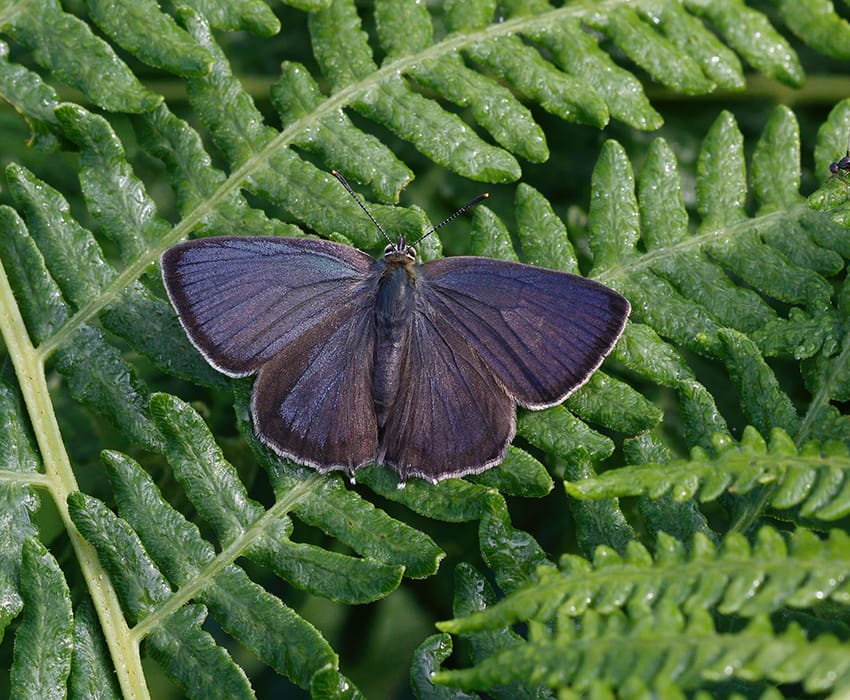
Purple Hairstreak
The Purple Hairstreak is a small butterfly that flies in the summer between the end of June and early September. It is very rarely seen as it spends most of its time perched on leaves at the top of oak trees. Very occasionally, it does come down to ground level, but it is best spotted with binoculars: males can sometimes be seen chasing each other in the treetops.
Found in oak woodland and on solitary oak trees in parks or along hedgerows.
Butterfly Conservation Priority: Low

Stag beetle
Stag beetles are one of the most spectacular insects in the UK. The male’s large jaws look just like the antlers of a stag. They spend most of their life underground as larvae, only emerging for a few weeks in the summer to find a mate and reproduce.
Stag Beetles live in woodland edges, hedgerows, traditional orchards, parks and gardens throughout Western Europe including Britain – but not Ireland. Stag Beetles are relatively widespread in southern England and live in the Severn Valley and coastal areas of the southwest. Elsewhere in Britain they are extremely rare or even extinct.
Conservation Priority: Stag Beetles are legally protected from sale in the UK. They are also classed as a ‘priority species’, listed on Schedule 5 of the Wildlife and Countryside Act 1981.
These magnificent beetles are Red listed in many European countries and have undergone a decline across Europe.

Elephant Hawk Moth
The Claydons Solar Action Group are asking for your assistance in helping us make a record of wildlife found in the area for the next year or two