
Mammals living on Rosefield

Weasel
Length: 17-22cm, Tail: 3-5cm, Weight: 55-130g
Average lifespan: 2 years
Conservation Status: Common.
About: Weasels are the UK’s smallest carnivore. They like to eat voles, mice and small birds. They belong to a group of animals known as mustelids, which means they have a long body and short legs and are related to otters and stoats. They live in lots of different habitats including woodland, grassland, and moorland. Their young are called kits, and they can have up to two litters a year with three to six kits per litter.
The weasel has a russet-brown back, and a creamy white throat and belly. It is smaller than the similar stoat, has a shorter tail with no black tip, and has a running gait, with a straight back; stoats bound along, arching their backs as they go.

Rabbit
Length: 40cm, Weight: 1.2-2kg
Average lifespan: 3 years
Conservation Status: Introduced, but naturalised species. Common.
About: Most people have spotted these animals grazing in long grasses looking for their favourite foods. They were first introduced to the UK by the Normans for food and fur but are now a common sight for many. They live in large groups in underground burrow systems known as ‘warrens’. Female Rabbits, called ‘does’ produce one litter of between three and seven babies every month during the breeding season – that’s a lot of little ones! Rabbits make a tasty snack for Stoats, Buzzards, Polecats and Red Foxes, which is why having a warren to hide in for shelter is so important.
The Rabbit is grey-brown in colour, with long ears and hind legs, and a fluffy white tail. It is smaller than the brown hare and does not have black tips on its ears.

Chinese Water Deer
Conservation status: IUCN Red List – Vulnerable.
About: As its name suggests this unusual deer is not a native UK species, having been introduced from China in the nineteenth century. It favours wet, marshy habitats and is a strong swimmer.
Chinese Water Deer are a ginger/brown colour and lack the white rump seen in other species. They are larger than a muntjac but slightly smaller than a Roe Deer. Their large fluffy ears and small black nose give them a teddy bear like appearance. The males possess some rather threatening looking tusks in place of canine teeth, which are used for displaying and rutting with other males in the breeding season.

Mole
Length: 15cm (plus a 4cm tail), Weight: 70-130g.
Average Lifespan: 3-4 years
Conservation Status: Common.
About: Moles are very rarely seen as they spend most of their lives underground. They are stocky animals, with a wedge-shaped body and short tail. They use their spade-like paws to dig tunnels and hunt for their favourite meal of earthworms. They also like to eat underground grubs that would usually feed off crops, so moles can help to control unwanted visitors!
By digging up the earth, moles help make the soil healthier by aerating it. This allows more types of plants to grow, which in turn feed more insects. Not only this, their tunnels improve soil drainage, which helps stop flooding and huge puddles forming on the ground. Moles truly are the unsung heroes of the animal world!
The mole is unmistakable. It is a stocky little animal, covered in black, velvety fur, with tiny eyes, a long, pink nose and two big, shovel-like 'hands' for front paws. You're more likely to spot mole hills (the piled-up earth from their burrowing) than the moles themselves.

Hedgehog
Length: 15-30cm, Tail: 1-2cm
Weight: up to 2kg
Average Lifespan: 2-3 years
Conservation Status: Protected in the UK under the Wildlife and Countryside Act, 1981. Priority Species under the UK Post-2010 Biodiversity Framework. IUCN Red List for British Mammals - vulnerable to extinction.
About: Round, brown and famously covered in spines, the hedgehog is the UK’s most familiar wild animal. They can be spotted in parks and gardens where bushes provide the perfect daytime getaway! They love long grass full of insects to feast on once the sun has set.
Hedgehogs eat all kinds of invertebrates, as well as amphibians, birds' eggs and anything else they can catch; they particularly like big, crunchy beetles and earthworms, making them a gardener's best friend. Hedgehogs hibernate over winter, from about November to April, in a nest of leaves or logs called a 'hibernaculum'.
A unique and unmistakable animal, the hedgehog is small, brown and round, with yellow-tipped spines over its back, and a fur-covered face. Mostly nocturnal, you may see or hear one snuffling around the garden. Or look out for the signs of hedgehogs, such as medium-sized, black droppings full of insect bits on the lawn.

Brown Rat
Length: 15-27cm, Tail: 10-24cm, Weight: 200-300g
Average Lifespan: 1-3 years
Conservation Status: Common
About: The brown rat is an incredibly adaptable mammal and can be found almost everywhere in the UK, in any habitat, all it needs is shelter and food. Brown rats are omnivorous, eating pretty much anything, from fruit and seeds to human food waste, insects, birds' eggs or even small mammals. They are particularly common around towns and cities. Brown rats live in loose colonies and dig their own burrows. They are famously good breeders; a female brown rat can breed from around 3 months old, and has an average of five litters a year, each of up to 12 young.
The brown rat has grey-brown fur, a pointed nose, large, bare ears and a long, scaly tail. It is much bigger than any mouse species. The similar water vole has a much rounder face, small ears that do not protrude, and a furry tail.

Pigmy Shrew
Length: 4-6cm, Tail: 3-4.5cm, Weight: 2-6g
Average Lifespan: 1-1.5 years
Conservation Status: Protected in the UK under the Wildlife and Countryside Act, 1981.
About: A small, insectivorous mammal, the Pygmy Shrew has tiny eyes and a large nose giving it a keen sense of smell. Shrews hectically snuffle through the undergrowth for their prey, which includes spiders and woodlice. Pygmy Shrews can be found in most habitats. Active by day and night, they are very territorial and aggressive for their size and can sometimes be heard fighting, their high-pitched squeaks particularly noticeable during the summer. Adults may only live for a year, just long enough to have one or two litters of around six young.
The Pygmy Shrew has tiny eyes, very small ears and a pointy face with a long nose. It is dark brown above and grey or silver below. It is smaller than the common shrew, and its tail is two-thirds the length of its body (common shrew tails are half the length of their bodies). It also has a smaller, narrower snout.

Badger
Length: 75-100cm, Tail: 15cm, Weight: 8-12kg
Average Lifespan: 5-8 years
Conservation Status: Protected in the UK under the Protection of Badgers Act, 1992, and the Wildlife and Countryside Act, 1981.
About: The black-and-white striped Badger is a well-known species in the UK. It is our largest land predator feeding on small mammals, birds’ eggs, worms, fruit and plants. Badgers live in large family groups in burrows under the ground called a ‘sett’. You know if a sett is lived in as it is usually neat and tidy with clean doorways marked with piles of used bedding made up of dry grass and leaves. There will also be a particularly smelly pit nearby that the Badgers use as a toilet! They have strong front paws, which they use to dig for food. Cubs are born in January or February but spend the first few months underground only coming out in spring when it is a little warmer.
An unmistakable animal, the Badger is large and grey, with a short, fluffy tail, black belly and paws, and a black-and-white striped face.

Brown Hare
Length: 50-70cm, Weight: 2-5kg
Average Lifespan: 2-4 years
Conservation Status: Protected in the UK under the Wildlife and Countryside Act, 1981. Priority Species under the UK Post-2010 Biodiversity Framework.
About: Thought to have been introduced into the UK in Roman times (or even earlier), the Brown Hare is now considered naturalised. It is most common on open farmland, in grassland habitats and at woodland edges, favouring a mosaic of arable fields, grasses and hedgerows. It grazes on vegetation and the bark of young trees and bushes. Brown Hares do not dig burrows, but shelter in 'forms', which are shallow depressions in the ground or grass; when disturbed, they can be seen bounding across the fields, using their powerful hind legs to propel them forwards, often in a zigzag pattern. Brown Hares are at their most visible in early spring when the breeding season encourages fighting or 'boxing'. Females can produce three to four litters of two to four young (known as leverets) a year.
The Brown Hare is golden-brown, with a pale belly and a white tail. It is larger than the rabbit, with longer legs and longer ears with distinctive black tips.

Red Fox
Length: 62-72cm, Tail: 40cm, Weight: 5-7kg
Average Lifespan: 2-3 years
Conservation Status: Common.
About: The Red Fox is our only wild member of the dog family. They are not fussy eaters and will happily munch on small mammals, birds, frogs, worms as well as berries and fruit! Foxes that live in towns and cities may even scavenge in bins to look for scraps. A male fox, called a dog makes a barking noise whereas the females, called vixens make a spine-chilling scream sound.
A medium-sized dog, the Red Fox is orangey-red above, white below, with black tips to the ears, dark brown feet and a white tip to the bushy, orange tail (known as the 'brush').

House Mouse
Length: 10cm, Tail: 10cm, Weight: 20g
Average Lifespan: 1 year
Conservation Status: Common.
About: As its name suggests, the House Mouse thrives wherever there are people, particularly in farm buildings, warehouses, sheds and garages, although it is no longer a common resident of our homes. It eats grains, seeds, roots, fungi and insects. House mice construct a series of tunnels to live in. Females can have up to 10 litters a year of four to eight young.
The House Mouse is grey-brown, with large ears, a pointed snout and long, scaly tail. The similar wood mouse is browner and has larger ears and eyes relative to its size.

Common Pipistrelle
Length: 3.5-4.5cm, Wingspan: 20-23cm, Weight: 3-8g
Average Lifespan: 4-5 years
Conservation Status: Protected in the UK under the Wildlife and Countryside Act, 1981. European Protected Species under Annex IV of the European Habitats Directive.
About: The Common Pipistrelle is our smallest and most common bat. All UK bats are nocturnal – preferring to come out only at night. They feed on midges, moths and other flying insects that they find in the dark by using echolocation. Common Pipistrelles don’t have to look far to find food, whether they live in the countryside or the city!
They roost in tree holes, bat boxes and even the roof spaces of houses, often in small colonies. During the summer, females form maternity colonies and have just a single pup each. Look out for Common Pipistrelles darting about as they hunt for insects in gardens or around streetlights just after sunset. They hibernate over winter, usually between November and April, but may come out to feed on warm days.
The Common Pipistrelle has dark, golden-brown fur, a slightly paler underside and a dark mask around the face. Its flight is rapid with lots of twists and turns. The Soprano Pipistrelle is similar in appearance, so the two can be difficult to tell apart.

Roe Deer
Length: 0.9-1.3m, Shoulder height: 60-75cm, Weight: 10-25kg
Average Lifespan: 7 years
Conservation Status: Common. Protected in the UK under the Deer Act 1991.
About: Our most common native deer, the roe deer tends to be solitary in summer, but forms small, loose groups in winter. The males have relatively short antlers, typically with three points. They begin to grow their antlers in November, shedding the velvet from them in the spring. By summer, they are ready for the rutting season. After mating, they shed their antlers in October and begin to grow a new set.
Roe deer live in areas of mixed countryside that include woodland, farmland, grassland and heathland. They eat buds and leaves from trees and shrubs, as well as ferns, grasses and heathers.
A slender, medium-sized deer, the roe deer has short antlers and no tail. It is mostly brown in colour, turning reddish in the summer and darker grey in the winter. It has a pale buff patch around its rump.

Common Shrew
Length: 5-8cm, Tail: 2-4cm, Weight: 5-14g
Average Lifespan: 1-2 years
Conservation Status: Protected in the UK under the Wildlife and Countryside Act, 1981.
About: A small, insectivorous mammal, the common shrew has tiny eyes and a large nose giving it a keen sense of smell. Shrews actively snuffle through the undergrowth for their prey, which includes earthworms, spiders and insect chrysalises. They can be found in most habitats, but prefer woodland and grassland. Active by day and night, they are very territorial and aggressive for their size and can sometimes be heard fighting, their high-pitched squeaks particularly noticeable during the summer. Adults may only live for a year, just long enough to have three or four litters of around six young.
The common shrew has tiny eyes, very small ears and a pointy face with a long nose. It is dark brown above, grey or silver below, and has chestnut-coloured sides. It is larger than the pygmy shrew, but its tail is only half the length of its body (pygmy shrew tails are two-thirds the length of their bodies).

Wood Mouse
Length: 8-10cm, Tail: 7-9.5cm, Weight: 25g
Average Lifespan: 1 year
Conservation Status: Common.
About: The Wood Mouse is sometimes known as the long-tailed field mouse and is widespread; it is probably most common in woodland, rough grassland and gardens. It is mostly nocturnal and an agile climber. Wood mice will gather food stores of berries and seeds in the autumn, which they keep in underground burrows or sometimes in old birds' nests. Females have up to six litters a year of between four and eight young, and may even breed over winter if food is abundant.
The Wood Mouse is golden-brown, with a pale underside, large ears and eyes, and a long tail. It is bigger than the harvest mouse, and browner in colour than the house mouse.

Muntjac Deer
Length: 77-91cm, Shoulder height: 45-52cm, Weight: 10-17kg
Average Lifespan: 10-13 years
Conservation Status: Invasive, non-native species. Protected in the UK under the Deer Act 1991.
About: The small, Chinese Muntjac Deer was introduced to Woburn Park in Bedfordshire at the start of the 20th century and rapidly spread into the surrounding area. It is now a common animal across southeast England and can be found in woodland, parkland and even gardens. Muntjac Deer are notorious browsers, eating the shoots from shrubs, as well as woodland herbs and brambles. This clearing of woodland understory has been linked to declines in species such as Nightingales.
Male Muntjacs have short, unbranched antlers that slope backwards, and a pair of long canine teeth. They breed all year-round, but females usually only have one kid at a time. Muntjac Deer are also known as 'barking deer' because of their dog-like calls.
A very small, stocky deer, the Muntjac Deer is about the same size as a medium dog. It is gingery-brown, with a pale underside, darker stripes in its face, and small, single-pointed antlers.

Grey squirrel
Length: 24-28.5cm, Tail: 19.5-24cm, Weight: 400-650g
Average Lifespan: 2-5 years
Conservation Status: The grey squirrel is classified as an invasive non-native species.
About: One of our most familiar mammals, the Grey Squirrel can be found in woods, gardens and parks across town and country, and often proves to be very tame. It is a frequent visitor to gardens with bird tables and feeders. Grey Squirrels feast on hazelnuts by cracking the shell in half. You may also find pine cones that have been nibbled, leaving what looks like an apple core behind. They will cache their food in autumn if it is abundant. Grey Squirrels make a rough nest, called a 'drey' out of twigs, leaves and strips of bark in the fork of a branch, high up in the tree canopy. Females may have two litters of three to four young a year.
The Grey Squirrel has a silver-grey coat, with a brownish face and feet, and pale underside. It has a characteristically bushy tail. It is distinguished from the red squirrel by its larger size, grey fur, and smaller ears without tufts. However, Grey Squirrels can vary in colour, with some appearing slightly ginger.
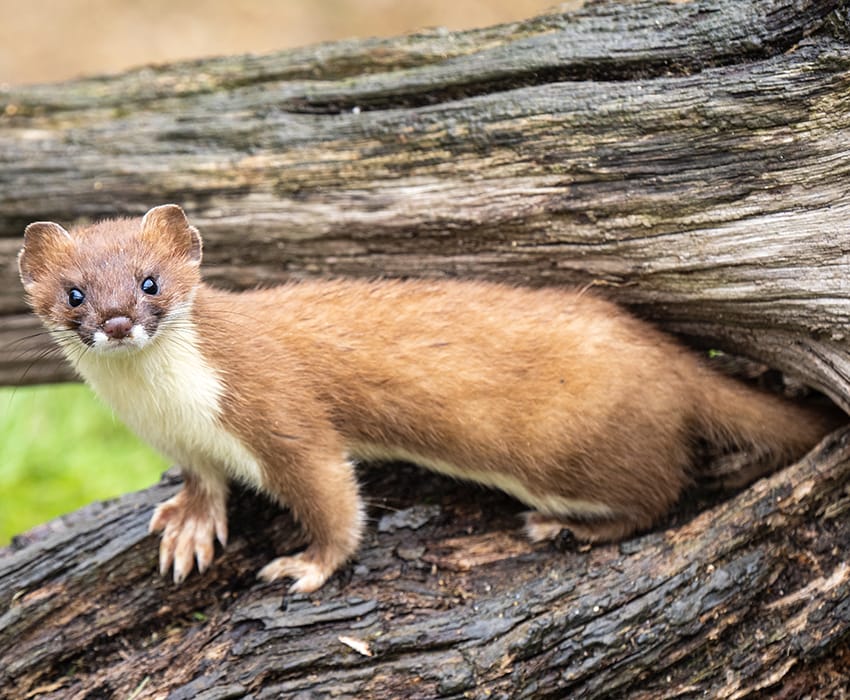
Stoat
Length: 24-32cm, Tail: 9-14cm, Weight: 140-450g
Average Lifespan: 2-5 years
Conservation Status: Common.
About: The Stoat is a small predator, with a long, low-slung body that makes it particularly well suited to hunting small rodents and rabbits. It can easily kill an adult rabbit, which is much larger than itself, with a bite to the base of the skull. Stoats are active by day and night and are easiest to spot in open habitats, such as sand dunes, grassland and heathland. They mate in summer but delay implantation of the fertilised egg until the spring of the following year. They have one litter of six to twelve kits a year.
The Stoat has an orangey-brown back, a creamy white throat and belly, and a black-tipped tail. It is larger than the similar weasel, has a longer tail and has a distinctive bounding gait, arching its back as it moves; weasels do not bound, but run close to the ground.

Field Vole
Length: 8-13cm, Tail: 3-4cm, Weight: 20-50g
Average Lifespan: 1 year
Conservation Status: Common
About: The Field Vole (also known as the short-tailed vole) is very common in grassland, heathland and moorland habitats. It is active day and night and eats seeds, roots and leaves. Further up the food chain, it forms an extremely important part of the diet of many predators, such as kestrels, weasels and barn owls. Field Voles are not great climbers, preferring to move along the ground through a network of well-used runs that lead to their burrows. They can produce three to six litters of up to seven young a year, and undergo population booms every few years. These increases don't last long, however, as they have short lifespans and fall prey to other animals.
The Field Vole is grey-brown above, and pale grey below. It has shaggier fur than the similar bank vole and a proportionally shorter tail (less than 30% of its body length). Voles have blunter, rounder faces, smaller ears and eyes, and shorter tails than mice.

HaRvest Mouse
Length: 5-7cm, Tail: 6cm, Weight: 4-6g
Average lifespan: 1.5 years
Conservation Status: Protected from deliberate cruelty under the Wild Mammals Protection Act. Priority Species under the UK Post-2010 Biodiversity Framework.
About: The tiny Harvest Mouse lives in long tussocky grassland, reedbeds, hedgerows, farmland and around woodland edges. It is mainly vegetarian, eating seeds and fruits, but will also eat invertebrates. Harvest mice build a spherical nest of tightly woven grass, high-up in the tall grasses, in which the female will give birth to around six young.
The Harvest Mouse has pale, ginger or yellow fur, and a white belly. Its tail is almost hairless and nearly as long as its body.

Noctule Bat
Length: 3.7-4.8cm, Wingspan: 32-40cm, Weight: 18-40g
Average Lifespan: 4-5 years
Conservation Status: Protected in the UK under the Wildlife and Countryside Act, 1981. Priority Species under the UK Post-2010 Biodiversity Framework. European Protected Species under Annex IV of the European Habitats Directive.
About: The Noctule is our largest bat. All UK bats are nocturnal, feeding on midges, moths and other flying insects that they find in the dark by using echolocation. Noctules roost in holes in trees and bat boxes, but rarely in buildings. During the summer, females form maternity colonies and have just a single pup. Noctules can be seen feeding on insects over the tree canopy; they particularly enjoy eating flying beetles, such as the large cockchafer. They hibernate over the winter, between November and April.
The Noctule has rich, golden-brown fur, with darker wings, ears and face. Its flight is characteristically strong and fast.
The Claydons Solar Action Group are asking for your assistance in helping us make a record of wildlife found in the area for the next year or two